Breakout Boss
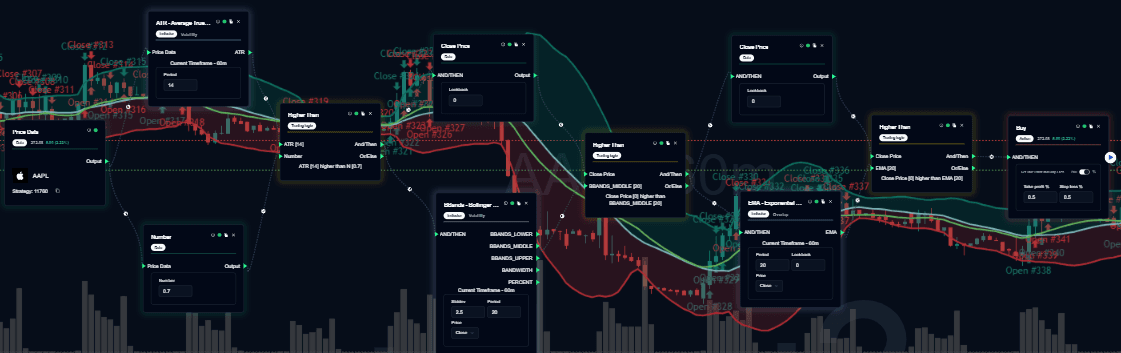
Strategy Overview
The Breakout Boss strategy is a high-conviction system built on the principle of “confluence.” Rather than relying on a single indicator, it requires three distinct market layers—Trend, Momentum, and Price—to align before a trade is executed.
By filtering for high-quality setups, this strategy aims to keep traders on the right side of the dominant market move while significantly reducing “whipsaws” during periods of uncertainty.
Indicators Used
| Component | Function |
|---|---|
| Moving Averages | Acts as the Trend Filter. It defines the bias (Bullish or Bearish) and ensures the strategy doesn’t trade against the prevailing flow. |
| RSI (14) | The Momentum Validator. It ensures that the trend has enough underlying strength to continue and isn’t overextended or “exhausted.” |
| Price Data | The Final Trigger. It monitors real-time price action to ensure the entry occurs at a structurally sound level. |
| Logic Blocks | The Decision Engine. These blocks (Higher Than, Crosses, etc.) act as the gateway, ensuring every rule is met before a trade is fired. |
Trading Logic
Entry Sequence
To ensure maximum reliability, the strategy follows a strict hierarchical confirmation process:
- Trend Establishment: The price must be positioned correctly relative to the Moving Averages. For a Long trade, the price should be above the averages.
- Momentum Check: The RSI must be in a “Strength Zone” (e.g., above 50 but below 70) to confirm that the trend has active buying interest without being overbought.
- Price Validation: The Current Price must break or hold a specific level to provide the final “go-ahead” for the Buy action.
Strategy Behavior
- Quality Over Quantity: Because it requires multiple conditions to be “TRUE,” this strategy trades less frequently than simple crossover systems but with higher confidence.
- Risk Discipline: Typically handles one position at a time to prevent over-exposure.
- Sideways Filter: Naturally stays sidelined during choppy markets because RSI or Price action will often fail to meet the strict confluence requirements.
When to Use This Strategy
✅ Best Suited For
- Trending Markets: Best performed when an asset is making clear higher-highs or lower-lows.
- Active Trading Hours: High-volume sessions where trends are more likely to be sustained.
- Liquid Instruments: Highly recommended for Major Indices, Blue-chip Stocks, and high-market-cap Crypto.
❌ Not Ideal For
- Range-Bound Markets: When the market is bouncing in a tight “box,” Moving Averages flatten out and signals become unreliable.
- Low-Volume Lulls: During “flat” periods (like late-session or holidays), there isn’t enough momentum to satisfy the RSI requirements.
- News Spikes: Sudden, vertical moves without technical structure can trigger entries that lack long-term follow-through.
Note: This documentation provides analytical structural recognition and is intended for educational purposes only. It is not financial advice.
Last updated on