EMA & Bollinger Momentum Breakout
Strategy Overview
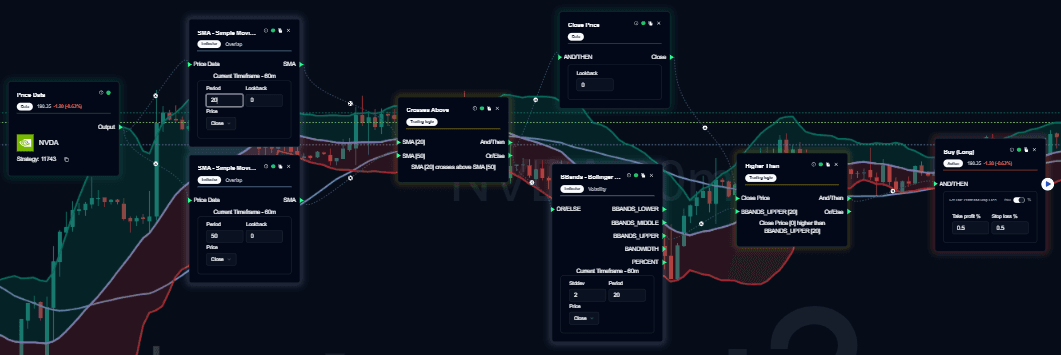
The EMA & Bollinger Momentum Breakout is a dual-confirmation system designed to capture high-velocity bullish moves. It layers a trend-following filter (EMAs) with a volatility breakout trigger (Bollinger Bands) to ensure trades are only taken when direction and energy are perfectly aligned.
By requiring both a trend shift and a volatility expansion, this strategy aims to eliminate “fakeouts” and participation in weak, sideways markets.
Indicators Used
| Indicator | Component | Function |
|---|---|---|
| EMA | 20-Period (Fast) | Captures immediate short-term momentum and price sensitivity. |
| EMA | 50-Period (Slow) | Establishes the medium-term directional bias. |
| Bollinger Bands | 20-Period / 2 StdDev | Measures market volatility and defines the “normal” trading range. |
How the Strategy Trades
Step 1: Trend Confirmation (EMA Crossover)
Before considering an entry, the strategy must confirm a bullish environment.
- Condition: The 20 EMA crosses above the 50 EMA.
- Market Context: This “Bullish Cross” indicates that the short-term momentum is accelerating faster than the medium-term trend, establishing a long bias.
Step 2: Price Strength Confirmation (Bollinger Breakout)
With the trend confirmed, the strategy waits for a surge in buying pressure.
- Condition: The Closing Price must be above the Upper Bollinger Band.
- Market Context: A price breaking the upper band indicates a statistically significant move and that the market is entering a “Volatility Expansion” phase.
Step 3: Buy Action (Long Entry)
A Long (Buy) order is executed only when both conditions are active simultaneously. This ensures that the trader is buying into a confirmed trend with explosive strength.
Strategy Behavior
- Momentum Alignment: Only occurs when the short-, medium-, and volatility cycles are all pointing upward.
- Volatility Filter: Bollinger Bands naturally contract during quiet periods, keeping the strategy sidelined during “choppy” price action.
- Disciplined Entry: The dual-filter approach reduces trade frequency but increases the probability of capturing significant trending moves.
When to Use This Strategy
✅ Best Used In
- Strong Trending Markets: When indices or stocks are making clear directional runs.
- Breakout Phases: Ideal for the first hour of the trading session (market open).
- Short-Term Timeframes: Highly effective on 5-minute to 15-minute charts for intraday scalping.
❌ Avoid Using In
- Mean-Reversion Markets: Avoid when the price is oscillating back and forth within a tight range.
- Low Volatility: Sessions with narrow Bollinger Bands (the “Squeeze”) often produce false signals until a clear direction is chosen.
- Against the Trend: Never enter if the 20 EMA is below the 50 EMA, even if the price breaks the upper band.
Note: This documentation provides only analytical structural recognition and is not a direct financial recommendation.