Trend Surfer
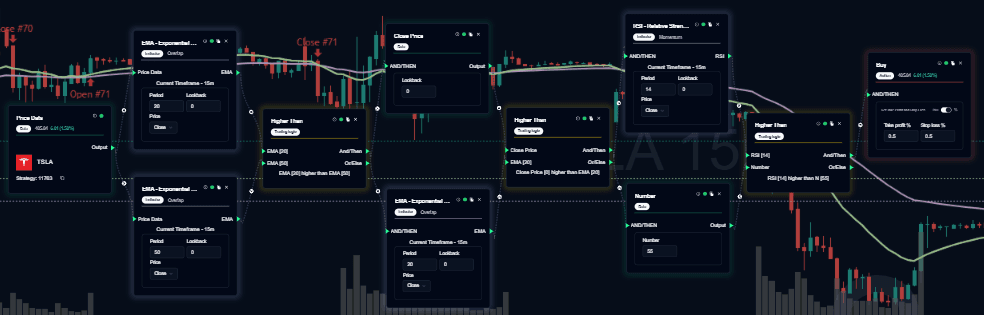
Strategy Overview
The Trend Surfer is a systematic framework designed to validate market direction through a strict confirmation sequence. Unlike aggressive entry models, this strategy acts as a “Gatekeeper,” ensuring that a trade is only considered when price structure, trend alignment, and momentum velocity are in perfect harmony.
The strategy emphasizes Confirmation Sequencing: each market layer must prove its strength before the execution node is activated, significantly reducing exposure to “false starts” and choppy price action.
Indicators & Components Used
| Component | Function |
|---|---|
| Instrument Selector | Centralizes the data source to ensure all price, trend, and momentum calculations are perfectly synchronized on the same asset. |
| Exponential Moving Averages (EMAs) | Acts as the Trend Detection Layer. By using multiple EMAs, the strategy distinguishes between a true trending environment and a simple sideways consolidation. |
| RSI (14) | The Momentum Validator. It ensures that the price movement is backed by actual strength, preventing entries into “exhausted” trends. |
| Logic Blocks | The Flow Control Engine. These blocks enforce “Higher Than” and “Sequential” comparisons, ensuring the strategy only moves forward if every rule is satisfied. |
| Execution Block | The Action Node. This is the final terminal that triggers only when the entire logical chain returns a “TRUE” status. |
Trading Logic
Entry Conditions (Execution Eligibility)
To achieve execution eligibility, the market must pass through a multi-stage validation process:
- Directional Structure: The Close Price must align above the defined EMA levels. This confirms the immediate bias is bullish.
- Trend Consistency: The Short-term EMA must be correctly positioned relative to the Longer-term EMA. This ensures the trend is structurally sound and not just a temporary spike.
- Momentum Confirmation: The RSI must exceed a configured threshold. This proves there is enough “fuel” in the move to sustain a continuation.
- Sequential Validation: The strategy does not allow “partial” hits; every condition must hold true simultaneously for the execution node to fire.
Strategy Behavior & Benefits
- Anti-Whipsaw Filter: By requiring both EMA alignment and RSI strength, the strategy naturally stays sidelined during “trend flips” and choppy periods.
- Deterministic Logic: The strategy’s rule-based nature removes human emotion, providing a consistent, repeatable execution framework.
- Prioritized Quality: This system favors “Quality over Quantity,” waiting for the highest-probability moments where the trend and momentum are fully synchronized.
- Fully Automated: Designed for seamless integration into systematic evaluation and execution control platforms.
When to Use This Strategy
✅ Best Suited For
- Clear Trending Markets: Assets exhibiting smooth, directional price expansion.
- Intraday Timeframes: Most effective on 5-minute and 15-minute charts where trends are well-defined.
- High-Liquidity Instruments: Best performed on major Indices, Blue-chip Stocks, and high-volume ETFs.
- Directional Sessions: Ideal for the high-volume hours of the London and New York market openings.
❌ Not Ideal For
- Range-Bound Markets: In sideways “box” ranges, moving averages will flatten and produce conflicting signals.
- Low-Volatility Conditions: During market lulls, the RSI often fails to meet the momentum threshold, leaving the strategy idle.
- Trend Flip Periods: Avoid during major news reversals where price action becomes erratic, and structure breaks down.
Note: This documentation provides analytical structural recognition and is intended for educational purposes only. It does not constitute financial advice or direct execution instructions.