RSI Oversold Reversal
Strategy Overview
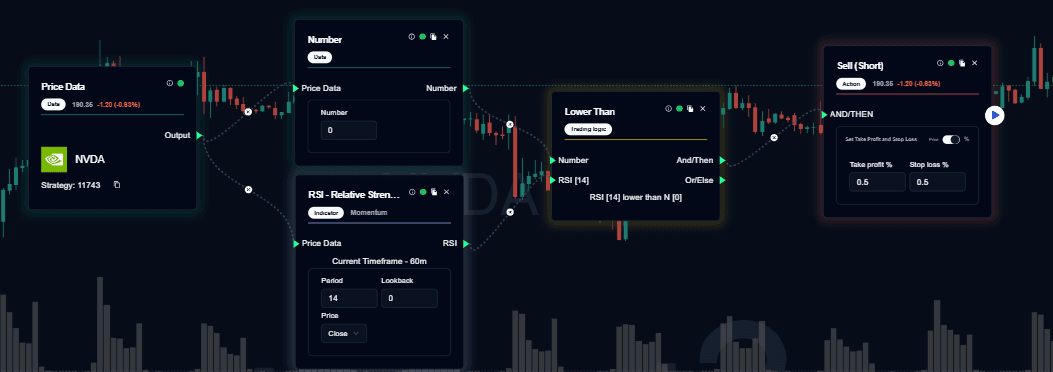
The RSI Oversold Reversal is a short-side system designed to capitalize on mean-reversion. It targets assets that have become technically “oversold” and seeks to enter a short position when downside momentum shows signs of exhaustion or when a weak bounce precedes a secondary drop.
This strategy is highly effective for intraday reversals and short-term swing trades, particularly following sharp, high-volatility sell-offs.
Indicators Used
| Indicator | Purpose |
|---|---|
| Relative Strength Index (RSI - 14) | Measures price momentum on a scale of 0 to 100. It helps identify extreme market conditions where selling pressure may be overextended. |
| Fixed Threshold (30) | A constant benchmark value. An RSI reading below 30 is the industry standard for “Oversold” territory, suggesting a potential pause or reversal in price. |
Trading Logic
Sell Condition (Short Entry)
The strategy initiates a Short position based on the following momentum exhaustion criteria:
- Condition: RSI (14) falls lower than 30.
- The Signal: This indicates the asset has experienced intense downside momentum and is currently in an oversold state.
- The Logic: Instead of chasing the initial crash, the strategy identifies that selling pressure is nearing exhaustion. It prepares to capture the next phase of the move or a failed recovery attempt.
Execution Action
- Entry: A Sell (Short) order is executed immediately once the RSI falls below the 30 threshold.
- Risk Management: Take Profit (TP) and Stop Loss (SL) levels are predefined within the Sell execution block to ensure controlled exits.
- Confirmation: The trade is finalized only when the closing candle confirms the oversold condition.
Strategy Behavior & Characteristics
- Extreme Condition Focus: The system remains idle during “normal” market activity and only triggers during extreme price extensions.
- Patience-Based: Does not trade continuously; it waits for specific mathematical “oversold” setups.
- Rule-Based: Eliminates emotional decision-making by relying on a fixed numerical threshold.
- Volatility Dependent: Performs best when there is enough price movement to push RSI into extreme zones.
Market Applicability
✅ Best Market Conditions
- Mean-Reversion Environments: Markets that tend to “snap back” to average prices after big moves.
- High Volatility: Stocks or assets experiencing strong, fast-paced recent moves.
- Short-Term Pullbacks: Identifying the end of a “weak bounce” in a broader bearish context.
❌ Conditions to Avoid
- Strong Upward Trends: Entering short trades in a powerful bull market can be risky, as RSI can remain overbought for long periods.
- Persistent Downtrends: In very heavy “crash” scenarios, RSI can stay below 30 (oversold) for an extended time. Entering too early without a confirmed turn can result in losses.
Disclaimer: This strategy represents analytical pattern identification for structural recognition. It does not constitute financial advice or direct execution instructions.
Last updated on