Range Rover
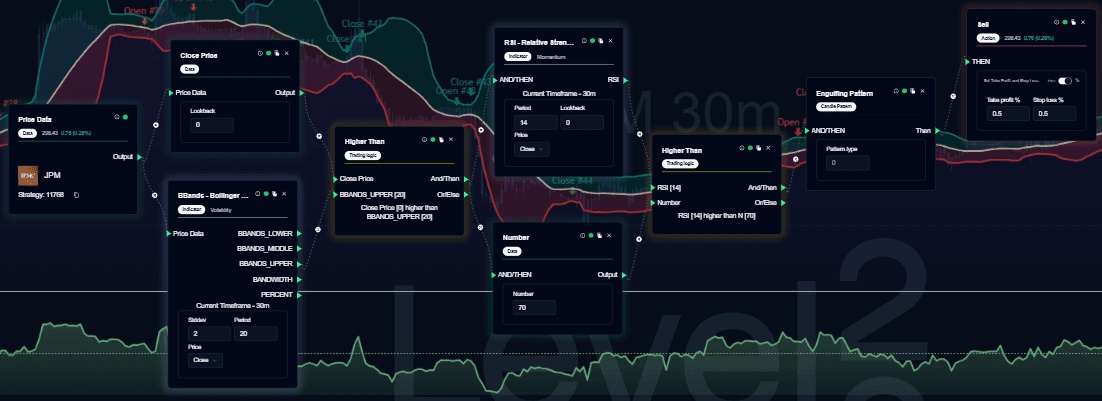
Strategy Overview
The Range Rover framework is a systematic approach to confirming market direction through the lens of price positioning and volatility context. Unlike predictive models, this strategy acts as a “validator,” ensuring that current price action is structurally sound relative to recent market history.
By layering closing price data with range-based analysis, the system identifies high-conviction environments where price strength and volatility are in harmony.
Indicators & Components Used
| Component | Function |
|---|---|
| Close Price Block | Provides the finalized, non-repainting market value. It serves as the definitive “anchor” for all structural comparisons. |
| Rolling Range Indicator | Measures the high-to-low span over a specific lookback period. It provides the volatility context necessary to determine if a move is significant or just noise. |
| Price Comparison Logic | A mathematical gatekeeper that evaluates if the current price is positioned favorably (e.g., in the upper portion of the recent range). |
| Sequential Logic Blocks | Ensures that the validation follows a strict order, preventing “false positives” that occur when conditions are only temporarily met. |
Strategy Logic
Validation Conditions
An analytical signal is output only when the market passes through a three-stage verification process:
- Directional Strength: The Closing Price must remain above defined structural reference levels. This proves that buyers are maintaining control at the close of the period.
- Volatility Alignment: The Recent Price Range must support the current move. If the range is too tight (compression) or too wide (exhaustion), the signal remains invalid.
- Simultaneous Convergence: Every logical check—Price, Range, and Sequence—must return a TRUE value at the same moment.
[Image diagram showing sequential validation steps from price confirmation to range alignment]
Strategy Behavior & Benefits
- Anti-Prediction Bias: By focusing on confirmed behavior rather than “guesses,” the strategy avoids the common pitfall of trying to pick tops or bottoms.
- Whipsaw Reduction: Filters out erratic price movement and range compression that often leads to “fakeouts” in simpler systems.
- Structural Consistency: Ensures that a move has both the position (Price) and the room to move (Range) before validating.
- Deterministic: Every signal is based on fixed mathematical rules, making it ideal for systematic trading and automation.
When to Use This Strategy
✅ Best Suited For
- Intraday & Short-Term Analysis: Highly effective on 15-minute and 1-hour charts where structure is well-defined.
- Stable Liquidity: Best performed on major indices, forex majors, and large-cap stocks.
- Sustained Behavior Validation: Ideal for confirming that a breakout has transformed into a sustainable trend.
❌ Not Ideal For
- News-Driven Volatility: Avoid during high-impact economic releases, when prices can bypass structural logic instantly.
- Low-Volatility Environments: When the Rolling Range is extremely narrow, the strategy may lack sufficient data to generate a valid signal.
- Erratic Instruments: Assets with “gappy” price action or low daily volume that lack smooth structural flow.
Note: This documentation provides analytical structural recognition and is intended for educational purposes only. It does not constitute financial advice or direct execution instructions.