Golden Cross Tracker
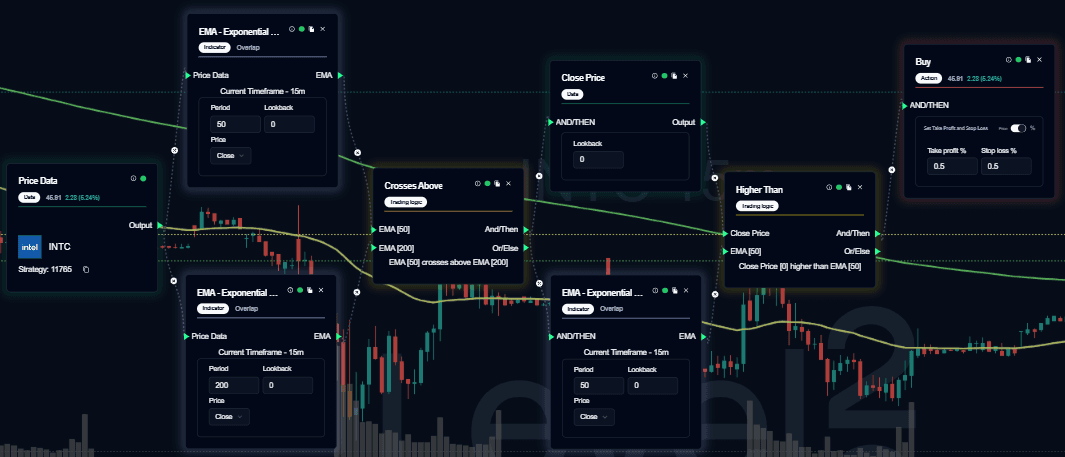
Strategy Overview
The Golden Cross Tracker strategy is a systematic trend-following system. It avoids the risk of “bottom fishing” by requiring the market to prove its directional bias through alignment with moving averages and price stability.
The core philosophy is simple: Wait for the structure to form, then follow the strength. By requiring both a trend crossover and a price-level validation, the strategy filters out weak bounces and focuses on sustained momentum.
Indicators & Components Used
| Component | Function |
|---|---|
| Short-term EMA | Captures immediate momentum. Its sensitivity allows the strategy to react quickly to emerging shifts in price. |
| Longer-term EMA | Establishes the “Trend Anchor.” It smooths out market noise to represent the broader directional bias. |
| EMA Crossover Logic | The structural trigger. It validates that short-term momentum has officially overtaken the long-term trend. |
| Price vs EMA Logic | The strength filter. It ensures the price is not just “passing through” but is actively holding above dynamic support levels. |
Trading Logic
Validation Conditions
The strategy utilizes a sequential “Gatekeeper” logic. A signal is only validated when every condition in the chain returns TRUE:
- Structural Confirmation: The Short-term EMA must cross and remain Above the Longer-term EMA. This confirms the trend structure is officially bullish.
- Price Position: The Current Price must be Higher Than the EMA support levels. This ensures the market isn’t in a deep correction or failing to find buyers.
- Final Signal: Only once both the “Moving Average Map” and the “Price Action” agree does the strategy output a trend-confirmation signal.
Strategy Behavior
- Deterministic Execution: Eliminates guesswork by relying on fixed, rule-based mathematical thresholds.
- Trend Specificity: Specifically designed to avoid “EMA Entanglement” (where averages weave back and forth) by requiring a clear crossover.
- Momentum Filter: By checking whether the price is above the EMA, it avoids entering trades during weak pullbacks when the trend might be failing.
When to Use This Strategy
✅ Best Suited For
- Strong Directional Markets: Markets that exhibit clear, stair-stepping price action.
- Intraday Momentum: Highly effective on 5-minute and 15-minute charts during high-volume sessions.
- Smooth Trending Instruments: Best performed on Indices (like the Nasdaq-100) or growth stocks with consistent momentum.
❌ Not Ideal For
- Range-Bound Markets: In sideways “box” markets, EMAs will produce frequent, unprofitable crossovers.
- Low-Volatility Conditions: When price action is flat, the distance between EMAs narrows, increasing the risk of false signals.
- Mean-Reversion Environments: Not designed to trade the “snap back” to the average; this strategy only trades the extension away from it.
Note: This documentation provides analytical structural recognition and is intended for educational purposes only. It does not constitute financial advice or execution instructions.