Trend Following EMA Crossover
Strategy Overview
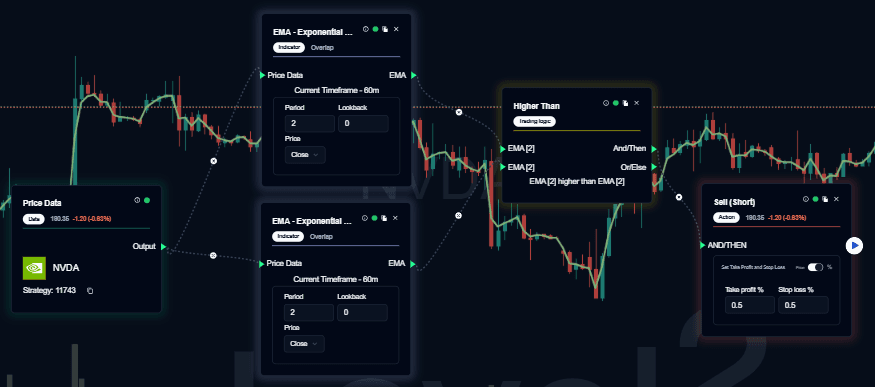
The Trend Following EMA Crossover is a momentum-based system designed to capture the meat of a market trend. It utilizes two Exponential Moving Averages (EMAs) to identify structural shifts in price direction.
The core philosophy is momentum-driven longevity: enter when the trend is confirmed and stay in the trade as long as the moving averages remain aligned. The integrated Smart Exit logic ensures that the position is closed as soon as the trend shows signs of structural failure.
Indicators Used
| Component | Function |
|---|---|
| Price Data | Uses the Closing Price to provide a stable, finalized input for average calculations. |
| Fast EMA | A short-period average that reacts aggressively to recent price fluctuations, capturing immediate momentum. |
| Slow EMA | A longer-period average that smooths out “noise” to represent the underlying broader market trend. |
| Higher Than (Logic) | The comparison engine that determines the bullish or bearish state of the market. |
| Sell | A protective action block that automates the transition from “active” to “closed” based on trend exhaustion. |
Trading Logic
Entry & Holding Logic
The strategy maintains an active Long position based on structural alignment:
- The Condition: The Fast EMA must be Higher Than the Slow EMA.
- The Signal: This “Golden Cross” alignment indicates that short-term buyers are outperforming the long-term average, suggesting a sustained uptrend.
- The Holding Phase: The position remains open as long as this relationship holds, allowing the trader to “ride” the trend through minor volatility.
Sell(Short)
The Sell(Short) is designed to act as both a profit-taker and a capital-preservation tool. It triggers automatically when:
- Trend Reversal: The Fast EMA falls below the Slow EMA.
- Weakness Detection: Internal logic detects that momentum has stalled, even if a full crossover hasn’t occurred yet.
Benefits of Selling Short:
- Prevents “giving back” profits during a major trend reversal.
- Removes the emotional difficulty of deciding when to close a winning trade.
- Reduces drawdown by exiting before a pullback turns into a crash.
Strategy Behavior & Benefits
- Trend Capturing: Specifically designed to ignore small fluctuations and focus on large directional moves.
- Whipsaw Reduction: By using EMAs instead of simple MAs, the strategy places more weight on recent data, often leading to cleaner signals.
- Adaptive: The logic naturally adjusts to the volatility of the specific asset being traded.
Market Applicability
✅ Best Used In
- Trending Markets: Assets showing clear “Higher Highs” and “Higher Lows.”
- Liquid Pairs: Highly active markets like Forex (e.g., EUR/USD) or Major Indices (e.g., S&P 500).
- Swing Trading: Excellent for capturing moves that last several days or weeks.
❌ Avoid Using In
- Range-Bound Markets: When prices move sideways, EMAs tend to flatten and cross frequently, leading to “whipsaws.”
- Low Volatility: Sessions with no clear direction (e.g., holiday trading).
- Sharp Whipsaws: High-impact news events can cause temporary crosses that don’t result in a true trend change.
Note: This documentation provides only analytical structural recognition and is not a direct financial recommendation.