RSI Sniper
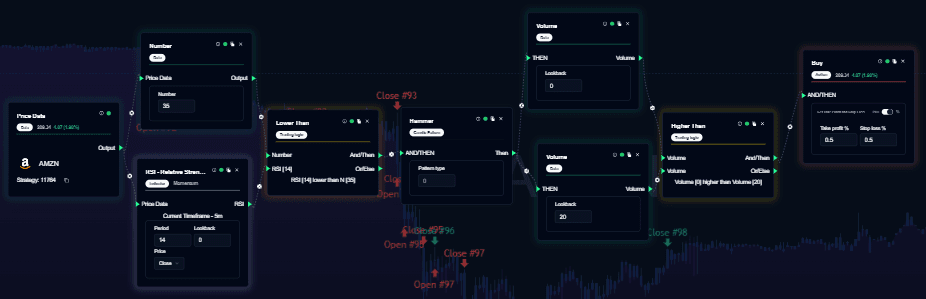
Strategy Overview
The RSI Sniper strategy is a high-conviction framework designed to detect expansion moves that are backed by genuine market participation. It operates on the principle that a price breakout is only as reliable as the volume supporting it.
This system acts as a validator: it ensures that price movement isn’t just a low-liquidity “fakeout” but a meaningful expansion where buyers or sellers are actively committing capital.
Indicators & Components Used
| Component | Function |
|---|---|
| Instrument Selector | Centralizes the data source to ensure price and volume calculations are perfectly synchronized across the same asset. |
| Close Price Block | Uses finalized candle data for structural evaluation, filtering out the “noise” of intrabar price spikes. |
| Threshold Logic | A configurable benchmark that defines the “line in the sand” for price levels or range validation. |
| Price Comparison | Identifies specific price states, such as a compression or a pullback, to establish a valid precondition for the move. |
| Volume Indicator | The primary confirmation filter. It quantifies market conviction and filters out weak, low-energy price fluctuations. |
| Higher Than (Volume) | The expansion trigger. It compares current participation against a baseline to confirm that activity is increasing. |
Trading Logic
Validation Conditions
A signal is only produced when the market passes through a two-layer verification process:
- Price Precondition: The Current Price must satisfy a structural comparison (e.g., crossing a threshold or recovering from a “Lower Than” state). This ensures the price is positioned correctly for a move.
- Volume Expansion: Simultaneously, the Current Volume must be Higher Than its previous baseline. This confirms that the price move has “fuel” behind it.
- Sequential Agreement: The logic ensures that volume isn’t analyzed in a vacuum; it must align with the specific price structure defined in step one.
[Image diagram showing the sequence: Price Threshold Breach + Volume Surge = Validated Signal]
Strategy Behavior & Benefits
- Participation-Based: Naturally avoids trading during “dead” market hours (lunch breaks, holidays) where price moves can be erratic due to low liquidity.
- Breakout Filtering: By requiring volume to be higher than average, it filters out “weak” breakouts that often lead to immediate reversals.
- Deterministic: Every signal is based on fixed mathematical comparisons, removing the emotional “guesswork” from trend validation.
- Systematic: Highly suitable for automated scanning across multiple markets to find the most active instruments.
When to Use This Strategy
✅ Best Suited For
- Breakout & Continuation: Validating the start of a new trend or the resumption of an existing one.
- Intraday Momentum: Most effective on 5-minute and 15-minute charts during high-volume sessions.
- High-Liquidity Instruments: Best performed on Blue-chip Stocks, Indices (S&P 500, Nasdaq), and Major Crypto.
- Active Sessions: Ideal for the London and New York market opens.
❌ Not Ideal For
- Low-Volume Environments: Avoid during late-night sessions or markets with poor participation.
- Compressed Sideways Ranges: If price is stuck in a tight box without a clear threshold breach, volume surges may be deceptive.
- Illiquid Assets: Thinly traded stocks where a single trade can skew volume data, leading to false positives.
Note: This documentation provides analytical structural recognition and is intended for educational purposes only. It does not constitute financial advice or direct execution instructions.