Smart Money Shadows
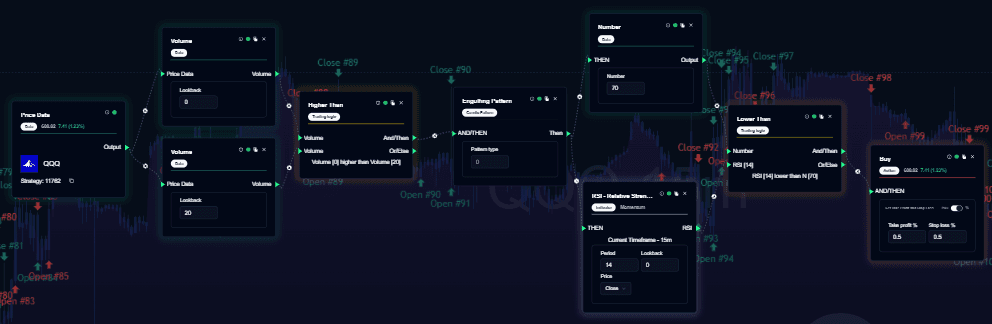
Strategy Overview
The Smart Money Shadows is a systematic, rule-based approach designed for short to medium intraday timeframes. Unlike speculative models that attempt to predict reversals, this strategy is built on the principle of Validation.
Execution is only permitted when price structure, trend alignment, and momentum velocity all converge. By requiring this “triple-filter” confirmation, the strategy aims to keep traders out of low-energy, sideways markets and positioned only in high-probability continuation moves.
Indicators & Components Used
| Component | Function |
|---|---|
| Exponential Moving Average (EMA) | Serves as the Trend Alignment Filter. Its weighted calculation reacts faster to recent price changes, providing a clear “line in the sand” for directional bias. |
| Current Price | The Market Structure Reference. It monitors real-time positioning to ensure the price is holding above dynamic support. |
| RSI (14) | The Momentum Engine. It quantifies the strength of the current move, ensuring that a trend isn’t just drifting but is backed by aggressive participation. |
| Logic Blocks | The Sequential Gatekeepers. These blocks enforce “Higher Than” comparisons, ensuring no single indicator can trigger a trade in isolation. |
Trading Logic
Entry Conditions (Execution Logic)
The strategy operates under a strict “All-or-Nothing” logical protocol. The execution block is activated only when the following conditions are simultaneously met:
- Trend Confirmation: The Current Price must be Higher Than the EMA. This confirms that the immediate bias is aligned with the prevailing trend.
- Momentum Validation: The RSI must be above a predefined threshold (e.g., 50 or 55). This ensures the move has the “velocity” required for continuation.
- Logical Convergence: Every upstream logic block must return a TRUE value. If momentum fades while price stays high, or price dips while momentum stays high, the system stays sidelined.
Strategy Behavior & Benefits
- Directional Focus: Exclusively filters for trending environments, reducing the risk of “whipsaws” during consolidation.
- Low-Energy Filter: Naturally avoids entering trades when the RSI is flat or declining, protecting capital during market lulls.
- Rule-Driven Discipline: By utilizing a centralized Execution Node, the strategy removes emotional hesitation and ensures every trade meets the same objective criteria.
- Scalability: The framework is highly adaptable to various risk management rules, including dynamic position sizing and automated SL/TP placement.
When to Use This Strategy
✅ Best Suited For
- Trending Market Environments: Where price exhibits clear “Higher Highs” and “Higher Lows.”
- Intraday Timeframes: Most effective on 5-minute and 15-minute charts.
- High-Liquidity Instruments: Best performed on Major Indices, Blue-chip Stocks, and high-volume ETFs.
- Active Market Sessions: Ideal for the London/New York overlap where directional bias is strongest.
❌ Not Ideal For
- Sideways or Range-Bound Markets: Where price frequently crosses the EMA without follow-through.
- Low-Volume Conditions: Avoid during “after-hours” or mid-day lulls where RSI signals lack conviction.
- Choppy Price Action: High-volatility environments with frequent, structureless reversals.
Note: This documentation represents analytical structural recognition only and does not constitute financial advice or direct execution instructions.